
Overview
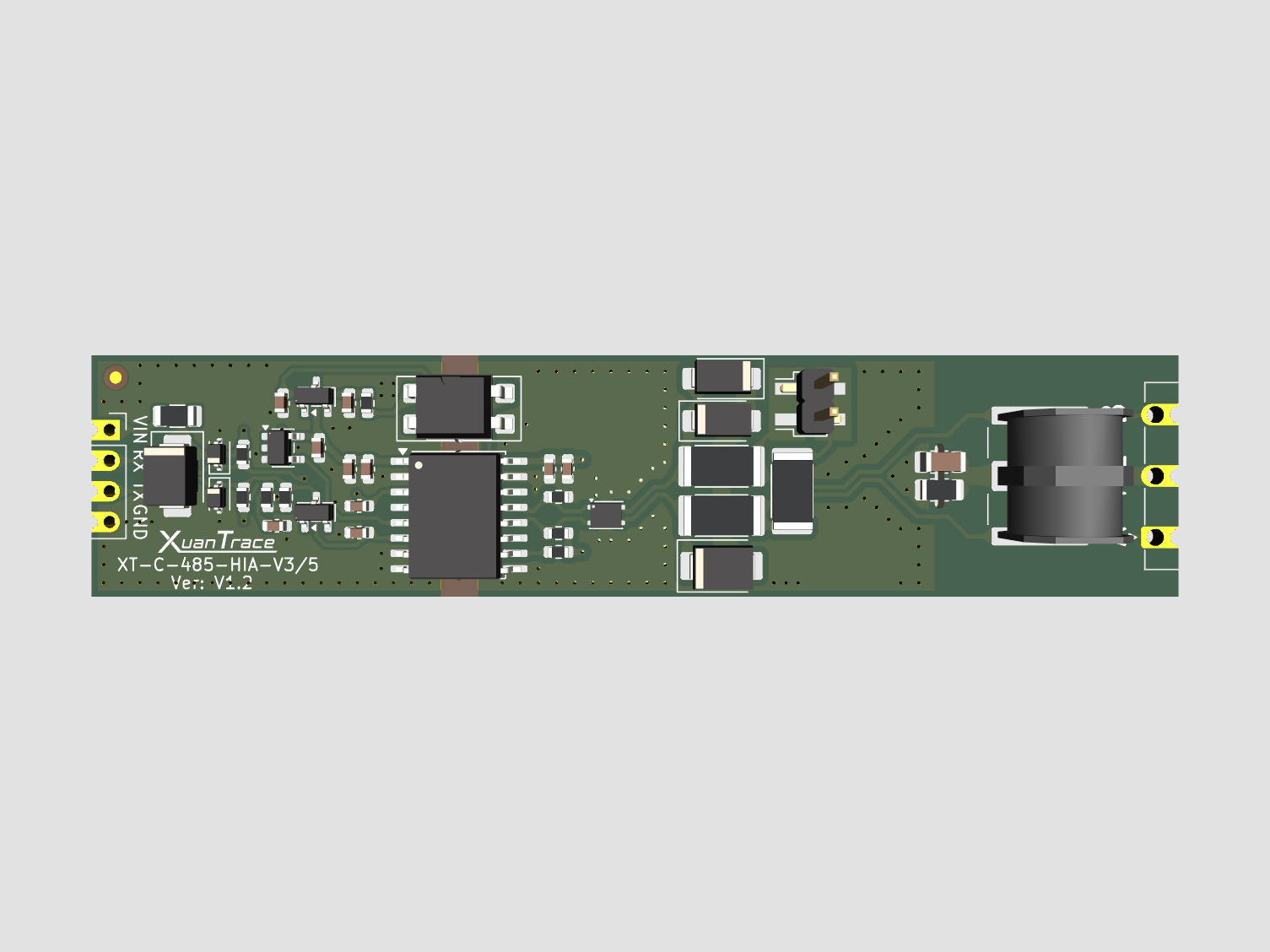
XT-C-485-HIA-V3/5 is an industrial isolated RS-485 half-duplex transceiver module. It turns one ordinary UART port (RX / TX) on your MCU into a galvanically isolated RS-485 bus interface with four-stage protection — all on a single 90 × 20 mm board.
At its core is the TDA51S485HC single-chip isolated transceiver: the isolated supply and the isolated signal path are integrated in one SOIC-16W package, so no external isolated DC-DC module and no optocoupler data path are needed — fewer speed bottlenecks, less drift and fewer failure points. The transceiver itself supports a 3.0–5.5 V wide input, 500 kbps and 1/8 unit load (256 nodes), and holds a defined high level when the bus is open, shorted or idle (fail-safe).
Beyond the isolated transceiver sits a complete port protection chain: gas discharge tube → bidirectional TVS → current-limiting resistors → common-mode choke, which blocks lightning-induced surges, VFD common-mode noise and wiring mistakes before they reach the transceiver. The topology follows the port protection circuit recommended in the transceiver datasheet rather than being a pile of parts.
Check before wiring
- Terminate
PEto earth nearby: the gas discharge tube usesPEas its discharge path; withPEfloating, surge protection is noticeably weaker. - Never short the isolated-side
PEto the logic-sideGND: once the two share ground, the isolation is gone. - The 120 Ω termination resistor is on-board: it is only connected when the jumper is closed, and only the two physical ends of the bus should close it — keep intermediate nodes open.
Key Features
- True galvanic isolation: the isolated supply and isolated signal are integrated in the TDA51S485HC; the logic side and the bus side need no common ground, with 5000 Vrms isolation withstand
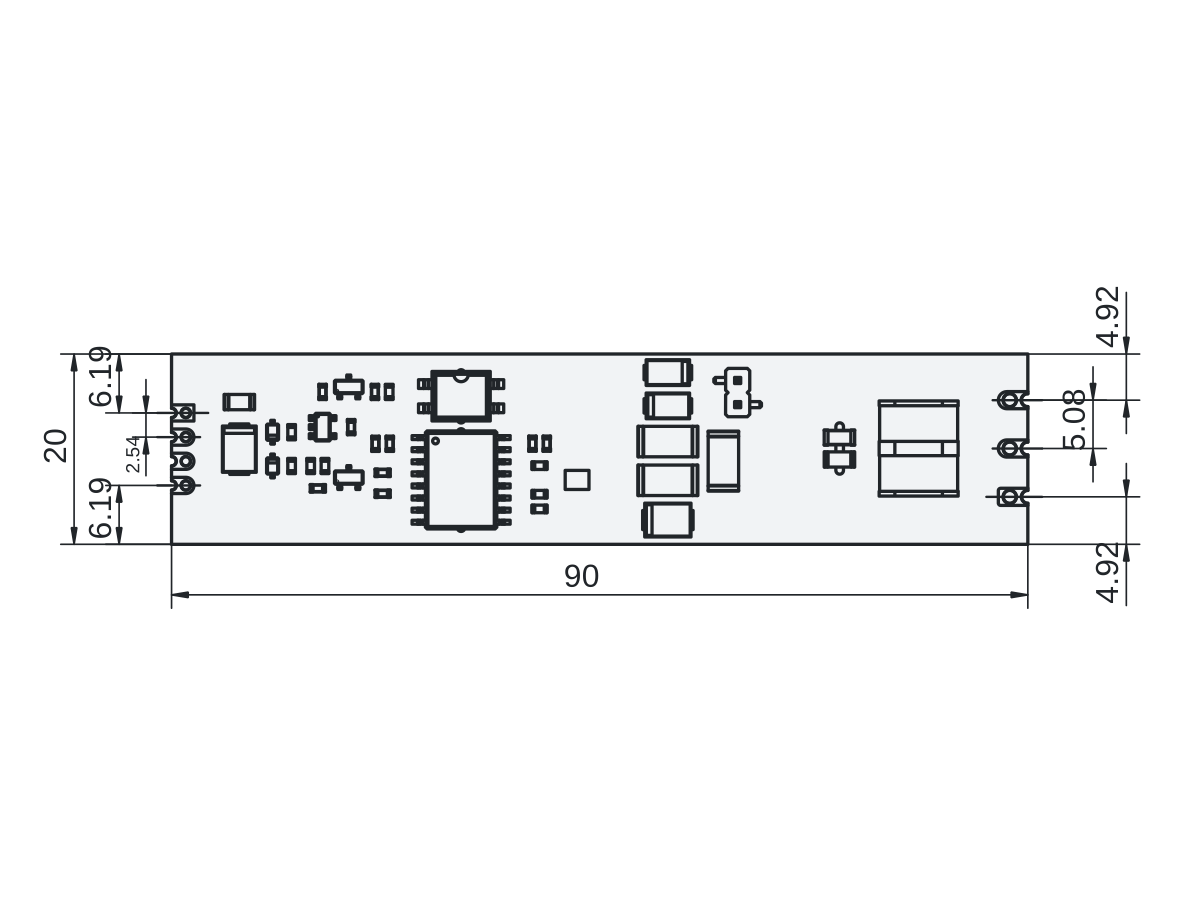
- Castellated SMD — and through-hole too: every pad carries both a castellated half-hole (stamp hole) at the board edge and a full plated through-hole, so you can either reflow the module flat like an SMD part or insert a 2.54 mm pin header / 5.08 mm terminal
- Four-stage bus protection: 3-electrode gas discharge tube (20 kA) + bidirectional TVS + current-limiting resistors + common-mode choke
- Automatic transmit/receive, zero firmware overhead:
TXdrivesRE/DEdirectly through a Schmitt trigger, so half-duplex direction switching happens automatically and the software never handles direction - Switchable 120 Ω termination: connected or disconnected with an on-board jumper — no soldering iron needed during field debugging
- Fail-safe biasing: on-board A pull-up / B pull-down bias keeps a defined level on an idle bus
- Wide input range: 3.0 – 5.5 V, with an on-board voltage detection circuit so the isolated-side output level tracks 3.3 V / 5 V systems
- Input and logic-side protection: 500 mA resettable fuse and input TVS, plus one ESD diode with RC filtering on each of
RX/TX - A design you can check: schematic, recommended pad dimensions and documentation are public — verify every protection stage before you buy
What's in the Box
- 1 ×
XT-C-485-HIA-V3/5module
Cables, enclosures and other accessories depend on the store SKU.
Applications
- MCU ↔ RS-485 isolation at VFDs, servos and motor drives
- Long buses with large ground potential differences: building automation, campuses, PV plants, EV charging piles
- Outdoor runs exposed to lightning and surges: access control, electricity meters, street lighting, weather stations
- Multi-drop networks of PLCs, instruments and sensors
- Industrial control cabinet retrofits, DIY and teaching
Specifications
| Parameter | Specification |
|---|---|
| Model | XT-C-485-HIA-V3/5 |
| Isolated transceiver | TDA51S485HC (isolated supply + isolated signal, SOIC-16W) |
| Supply voltage | 3.0 – 5.5 V (3.3 V / 5 V typical) |
| Supply current | 27.9 mA @ 3.31 V; 22.7 mA @ 5.01 V |
| Logic-side interface | VIN / RX / TX / GND, 2.54 mm pin header |
| Bus-side interface | B / PE / A, 5.08 mm pluggable terminal block |
| Communication mode | RS-485 half-duplex, automatic direction control (no direction-control signal needed) |
| Max data rate | 500 kbps |
| Bus load | 256 nodes (1/8 unit load) |
| Isolation withstand | 5000 Vrms |
| Common-mode transient immunity | 150 kV/μs (typical) |
| Bus ESD | ±15 kV contact discharge, ±8 kV HBM |
| Bus protection | Gas discharge tube + TVS + current-limiting resistors + common-mode choke |
| Surge discharge current | 20 kA (8/20 μs, TR091H 3-electrode gas discharge tube) |
| Termination resistor | 120 Ω / 1 W, on-board jumper connect/disconnect |
| Fail-safe biasing | On-board A pull-up / B pull-down bias resistors |
| Input protection | 500 mA resettable fuse + TVS |
| Logic-side protection | One ESD diode per RX / TX (PESD5V0S1BA) + RC filter |
| Operating temperature | −40 ~ +125 °C |
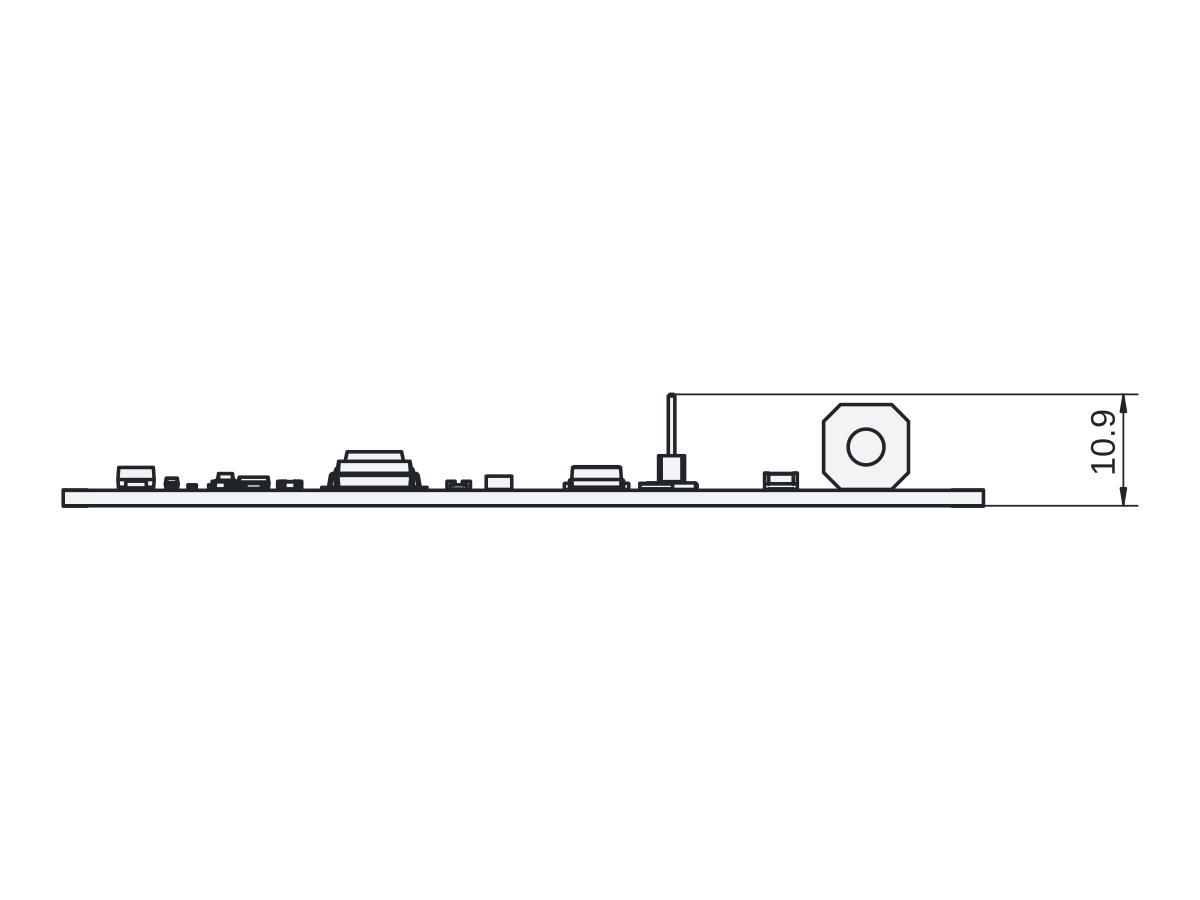
| Dimensions | 90 × 20 mm |
| Board thickness | 1.6 mm |
Usage Notes
- Termination: the 120 Ω resistor is on-board and jumper-switchable. Close the jumper only on the two physical ends of the bus; leave intermediate nodes open.
- Biasing: the module already provides A pull-up / B pull-down bias so an idle bus stays at a defined level. When you build a multi-node network, work out the parallel bias value of the whole bus.
- Wiring: run
A/Bas a twisted pair where possible and earth the shield at a single point; keepPEandGNDelectrically separate.
Comparison
| Feature | XT-C-485-HIA-V3/5 | Typical isolated RS-485 module | Non-isolated RS-485 module |
|---|---|---|---|
| Galvanic isolation (isolated supply + isolated signal) | ✅ | ✅ | ❌ |
| Single-chip isolated transceiver (integrated isolated supply) | ✅ | ❌ | ❌ |
| Surge gas discharge tube (20 kA) | ✅ | ❌ | ❌ |
| Bus TVS clamping | ✅ | ⚠️ | ❌ |
| Common-mode choke filtering | ✅ | ❌ | ❌ |
| Jumper-selectable 120 Ω termination | ✅ | ❌ | ❌ |
| Fail-safe bias resistors | ✅ | ⚠️ | ❌ |
| Input over-current protection (resettable fuse) | ✅ | ❌ | ❌ |
✅ Yes ⚠️ Partial ❌ No